Saturday, September 21, 2024

 The Substance

3.5 Stars (out of four)

Okay, everybody, I'm back! It's been awhile since I put something up here, ever since I did my review for Yesterday on July 7, 2019 (over five years ago, wow!) and my life has changed a lot since then. But one thing that HASN'T changed is my love for movies and I am going to start doing this again as I miss doing it. So, I decided to start with one of the strangest, and probably odd for me to talk to you about, movie that I have seen in some time. BE WARNED: This movie is NOT for everybody, you will need a strong stomach for several things whether it be the portrayal of women in a post-"Me Too" world or if you just don't like gore, but this movie is one of the profound things I have seen since "Ex Machina." The movie is written and directed (and produced and edited) by French independent filmmaker Coralie Fargeat, and boy, is this movie an AMAZING second feature film. She is 48, which shows it is never too late to make something truly great. This film has a LOT to say and I wanted to say something about it. It really hit me hard, and I have seen one of the next great talents in the movie industry, yet one who is willing to tear apart the very industry she works in. This movie is a fable that is both body horror and satire on several things with the blackest of black comedy and yet takes itself deadly serious. It has one of the most stinging, acidic and totally tears out the facade of society in general and society in specific. The ONLY reason this does not get four stars is how over-the-top the final scene is, but it is also genius as to how it skewers Hollywood. It is very much a middle finger to the industry.

First, what is it about? It is very hard to say WHAT it is about. On the one hand, it is a very straightforward body horror film, but to label it so minimizes what it is, the greatness of this film and cheapens its ultimate message. But first, let's just sum up the story briefly. Elisabeth Sparkle (played AMAZINGLY by Demi Moore, quite possibly the best performance of her career and one of the best this year), is a formerly famous actress that has now become the host of a very popular aerobics show, a la Jane Fonda in the Eighties, and is fired on her 50th birthday. She gets into a car accident on her way home as she sees a billboard of her is being taken down. While in the hospital, she is given a flash drive from a young nurse who says it changed his life. It is an advertisement of sorts for a potion called The Substance. The Substance will make a more perfect, more ideal version of you. Of course, Elisabeth ends up taking it, and a younger version of her (played by the beautifully sexy Margaret Qualley) is "birthed" from her back. We find out that this new avatar has to "Stablize" herself by extracting fluid from Elisabeth every day. She is also warned that each body are both the same person and each body has to switch into the other every seven days, NO EXCEPTIONS. The avatar names herself Sue and she basically takes over Elisabeth's exercise show and becomes an instant hit. As Sue/Elisabeth becomes enamored of her "new" life, she takes more and more time in Sue. The problem, as she finds out, is if the seven days are not followed, she will deteriorate. So as Sue becomes more selfish about her fabulous life, she is hastening her own death.

BUT, this film is REALLY about a lot of things: a commentary on the fake plasticness of Hollywood and the entertainment industry, the "invincibleness" of youth, the fact that world is an oyster to young beautiful women who use their sexuality as a kind of commerce-her only value, a commentary on the vapid sexualization of women in entertainment today, and finally, on a macro scale, it is an examination on growing older, especially for women, in a society that worships at the altar of youthful beauty and sexuality and what happens as one becomes older.

It is not a secret that women have "expiration dates" when they work in Hollywood with very few exceptions. Once they pass a certain age, usually somewhere in her mid-Thirties, she is no longer bankable and loses her "currency" of sexual appeal. But what happens when that currency is not worth as much as it used to be? What happens, when beauty is all you are, is no longer the case? Would you be willing to kill yourself if you could be younger? It also is an interesting take on the relationship of youth vs. age. Being young and beautiful in America opens so many doors. This has always and will always be the case. But this movie argues that the arrogance of youth will inevitably end up bad if you don't grow up, or at least be more faceted in your life. It is the classic Faustian story: What good is it to inherit the world when the piper comes calling for the payment?

Ms. Fargeat shows a real talent for both visual and lyrical metaphor. Besides the very odd story, the movie's tone has an otherworldly feel, based on how she shoots the film. She used a lot of low angles, distorted closeups and odd set design. Another interesting thing about his film is it very much works in what is stupidly called the "male gaze." The fact the oversexualization of Sue is making a critical point. It is commentary on how much sex permeates everything in entertainment, but it also a very primal part of our psyche, one that cannot be exorcised by modern attitudes about the role of the sexes. Sexual attraction is an inherent part of all of us, and today's entertainment industry uses this to make enormous dollars. And despite the fact we are in a post-Me Too period, we have become even more sexualized than ever before.

It is interesting that Demi Moore is the main character in this, because even at 50, frankly, she is still a VERY beautiful and sexy woman. I don't think many other women could pull this off. It seems tailor made for her and only she or a few other actresses could inhabit this role as they are the ones who actually set the bar for beauty in the past. It is similar to how nobody could have played the protagonist in Unforgiven EXCEPT Clint Eastwood or John Wayne, precisely because they set the precise archetypes and tropes for the character and story that Unforgiven gleefully tears apart. Demi is amazing in this role and quite frankly should get an Oscar for this performance. It is THAT good. But unfortunately, will not get it because of the movie's subject matter. The Academy would never take a horror movie seriously, and it is unfortunate, because this performance deserves that Oscar. Again, I will warn all of you that this film is not for everybody. On the one hand, the body horror is pretty disgusting, along the lines of the obvious inspiration of David Cronenberg's The Fly or Videodrome. It will also offend those with more prudish sensibilities. This movie has a LOT of graphic nudity and scene after scene of lingering on women's breasts, butts and legs. It is not for the squeamish or the ultra-conservative, but it IS a serious, profound and deep work that is so much more than the sum of its parts.


Sunday, July 7, 2019

Yesterday

4 Stars (out of four)

Every once in awhile a movie comes along that can grab my attention like no other and reminds we why I love the movies so much and keep coming back. In my life, at many times, they are all I have. They make me fall in love with the beauty all around us, demonstrating the real power of great stories, of great art. Long ago, in my review for Dazed and Confused, I said great art makes you feel something, it touches you deep in your soul and lifts you above the sum of the experience. This is what it was like for me watching Yesterday.

The plot is cute, but surreal. Jack Malik, a struggling musician (Himesh Patel, in a fantastic film debut), after being injured in a car accident, wakes up to a world which forgot The Beatles ever existed. He then tries to remember each song and performs them as his own and becomes an overnight sensation. But in many of these types of show business movies, all that glitters is not gold. The film has an ulterior motive as well, asking us: What if you got everything in the world you ever wanted or dreamed of, yet you were not happy? It turns out out Jack’s manager, Ellie Appleton (played sweetly and vulnerably by Lily James) loves him and has been his biggest cheerleader and supporter since they were teenagers. Everyone can see they are perfect for each other other than Jack. When she asks why he never loved her just before he leaves for stardom and celebrity, he makes the choice to leave, crushing her, and he realizes, himself. He feels torn because he feels as if he’s a thief and a fraud, and yet wants the world to hear some of the best music ever written.

This movie, at first blush, is a love letter to The Beatles and their music, but there is something much more than that. There is a beautiful, beating heart underneath about chances taken and lost, and the consequences of those decisions. The love story is not trite, but rather the soul of this movie, set to the soundtrack of the Beatles. It is really a story about love; love of family, friends, and yes, music. You don’t have to be a Beatles fan to like the movie, but if you are, it will get to you. I was totally swept away with the story until a surprise cameo totally shattered me and seduced me under its spell. The film is another masterpiece by Danny Boyle (Slumdog Millionaire, Steve Jobs-the good one with Michael Fassbender, 127 Hours, 28 Days Later, Trainspotting and Shallow Grave) , who is quickly becoming one of my favorite directors of all time. And while many of his movies are very dark themes, this is a ray of light. A truly great film that resonates not only with the greatness of The Beatles’ music, but also from what one wise man said, “All You Need Is Love.”


Sunday, March 17, 2019

What We Do In The Shadows

Three Stars (Out of Four)

What We Do In The Shadows is the story of Viago, Deacon, Vladislav, and Petyr, four flatmates in Queensland, New Zealand trying to work through all the issues that flatmates have: house chores, annoying habits, Learning about Facebook. Oh, and by the way, they are all vampires. We follow a documentary crew as we see their trials and tribulations dealing with the ordinary mundacity of life in the big city.

What We Do In The Shadows was created by the men behind Flight of the Concordes on HBO and follows a similar tone. While they are not following the annoying “too cool for school” approach from their TV show, they approach the subject matter with a very amusing matter-of-fact style. It follows the mockumentary style of This Is Spinal Tap andCrocodile Hunter: Collision Course,  It also takes on the very difficult to pull off meta style of humor. This movie pulled it off brillaintly following acts like: Young Frankenstein, Evil Dead III: Army Of Darkness, Scream, Sean Of The Dead, Hot Fuzz, Cabin In The Woods, and Tucker And Dale Versus Evil. The true brilliance of this film is how it totally skewers the pomposity of the vampire myth, perpetuated in Dracula, Interview With The Vampire, and the Underworld series. Whenever a story of vampires is told, they are all French or Russian aristocrats. While the HBO show Tru Blood did this a little, making vampires backwoods rednecks, but a lot of the overwrought tropes were there as well. It seems vampires are always young, haughty and rich fops, never normal people.

What I liked particularly about the film is the actual delivery of the humor. While there is a lot of over the top stuff, the funniest jokes are often very subtle digs at all parts of vampire mythology, with a little werewolf and zombie fun thrown in.  Americans seem to have a hard time with this, usually jamming humor down your throat while waving their arms and saying, “Look! We’re being funny!”  Good examples are anything starring Will Ferrell or Steve Carrell or the Madea and Scary Movie franchises. While these can occasionally have good jokes, they tend to be the theater of the overly absurd.  If you are not a fan of the horror genre, particularly vampires, this is not the movie for you. For those of you who love the unneutered vampire films before such dreck aimed at the teenage market like the Twilight series came out, you will love this film. It is a lot of fun.


Sunday, February 10, 2019

Mary Poppins Returns

3 Stars (out of four)

I was a little skeptical about this one. Mary Poppins was one of the best movies I have ever seen. It is wholesome, entertaining and holds up after fifty years. It is literally one of the best films ever made. How do you follow that up? Believe it or not, Disney has managed to make a pretty good go at it. Considering that Disney has been on a high horse lately with their live-action remakes with their ridiculous social-justice warrior themes, this is a refreshingly almost modern attitude free story and simply just an entertaining romp.

Basically, the film takes place about twenty years after the original Mary Poppins and follows the Banks children. They are now grown up and they have problems if their own. Mary Poppins (Emily Blunt, in a pretty good imitation of the original Julie Andrews performance) shows up out of the air to take care of the Banks children while money problems are sorted out at the bank. Of course, this means there will will be lovely song and dance numbers with amazingly imaginative and magical set pieces. The standout being when Mary and the children jump into a porcelain bowl. It is reminiscent of the time when Mary, Bert and the children jumped into Bert’s chalk drawings, and like that scene, animation and live-action mixes together in a charming way (or a most delightful one?).

In any case, is the movie any good. The answer is yes. While the songs are not quite as memorable as the original (an admittedly high bar), they are very fun and entertaining, even a bit catchy. While none of them are the masterpieces of the original, Disney went well out of its way to catch the atmosphere and charm of the original. The songs are as timeless sounding as the original with nary a modern twist that would immediately date the original. This also goes with the atmosphere of the entire movie. A very annoying thing about Disney’s new live-action remakes of their old properties has been a ridiculously heavy handed social justice warrior tendency. The wolf pack of The Jungle Book is led by an alpha-female, Belle is a modern, independently minded woman, Malificent is a misunderstood and wronged party, Lafoux is gay, etc, etc, etc. While I have never had a problem with strong female protagonists, the tendency of the Disney movies of today is to insert very modern atttidues to very old stories. This tends to take me out of the story because of the obvious agenda that goes with each movie. Instead, create something new that makes these cases instead of falling on old stories but imprinting 21st century attitudes on 19th century individuals. It is sloppy and lazy writing.

That said, Mary Poppins Returns is a surprisingly wholesome and relatively agenda-free piece of entertainment that thoroughly does what it is supposed to do, entertain. Not preach. The movie is long  on emotions and whimsy, which is just what Mary Poppins should be. The dance numbers are fun, but a tad unmemorable. I very much liked the film, and it was much better than I thought it would be, but it is not particularly a masterpiece. It is a perfectly acceptable and fun film that is great for all ages. I would recommend it for a fun, turn-your-brain-off-and-go piece of entertainment that should be loved by ironic-free minded people of all ages.


They Shall Not Grow Old

Four Stars (out of Four)

November 11, 2018 we celebrated the 100th Anniversary of Armistice Day, the end of World War I, a war of unfathomable destruction and waste, and sadly, only the opening act to the bloodiest conflict to the worst conflict in human history, World War II.  But for all the ink that World War II gets and how much it gets studied, surprisingly little is known about its bloody forebearer, World War I. And the sad thing is, no one seems to really care as much. Maybe because the motivations of World War II are so much easier to comprehend to several generations who don’t want to think too hard about history and its consequences, maybe because of the confused nature as to how World War I started, or maybe a combination of both, but those who study history realize that World War II was merely a continuation of the issues of World War I. In any case, They Shall Not Grow Old is not meant to be a documentary of the great issues, battles, or even the great truths World War I can teach us. In fact, it is the strangest documentary of its type that I have ever seen. It is the documentary, if that is the right word, of the experience of being a solider in the British Army during World War One. In a fascinating documentary about the documentary at the end of the movie, director Peter Jackson explains he wanted to make a story regarding the experience of the common solider during this most destructive conflict.

In this regard, the movie is surprisingly complete for the typical solider’s story. The movie originally started out as a project from the Imperial War Museum and the BBC to memorialize the 100th anniversary of Armistice Day. The Museum had hundreds of hours of film footage and the BBC hundreds of hours of interview material from the 70s and 80s from World War One veterans. The project that was handed to Peter Jackson was to use as much of this material to give the viewer and idea of what World War One was, which, from a historical perspective, is quickly becoming to be like a forgotten war. The film starts from the outbreak of war, to the initial recruitment drives, through the basic training, the wartime experiences, and finally the experiences back home after the war where the country had little use for the veterans and left them alone to deal with the horrors of what they had experienced, today what we would call Post Traumatic Stress Disorder (PTSD). The movie is astonishingly complete in the mundane and extraordinary experiences the men felt during this time.

But the movie does most historical documentaries one better. Unlike the footage from the countless other documentaries we have seen over the years, Peter Jackson and his crew took great steps to clean and restore the film as much as possible, and most astonishingly, realistically colorize it. Now this isn’t just any thrown together job of colorization that we have seen from movies in the past, this was an astonishing attempt to get the colors and atmosphere so correct that it is as if you were really there.  I was impressed by the History Channel’s superb documentaries, WWII In HD and Vietnam In HD that did basically the same thing, but this movie went the step further. Peter Jackson’s crew corrected the time difference of the hand-cranked 18 frames per second from filmed subjects back then to the correct 24 frames per second we are used to seeing today. When we look at historical footage, it has almost a surreal feel because of this technical problem. By correcting this, Jackson has made the footage even more real. He brought in lip readers so we could hear what the men were saying onscreen. He included foley effects from the real weapons so the film would sound right. He even brought actors from the same areas of England that the units were from so the accents would be right. This insane attention to detail brought a vitality to the men and their emotions that we see onscreen. There is absolutely nothing about this film that does not feel “real” in every sense of the word.

And what a payoff it is. It does a justice to these men who fought, suffered and died under the most hellish of circumstances by focusing on their experiences, their emotions, and ultimately their humanity. In this way, this was the most different documentary I have ever seen because it is a documentary of feelings, not cold facts and dates. It is almost wrong to call it a documentary, because it is a presentation of emotions and experiences, something that is usually subjective, which basically goes against a documentary’s usually mandate. Yet there is nothing untrue here. It is emotion laid bare and raw, worthy of the finest storyteller, and yet it is all real. This is a work of immense achievement, not for its breadth and scope, but for its intimacy of such a large subject. Ultimately, it succeeds so well where other documentaries fail so utterly; it is a true memorial to the men of whom it’s about, a towering feat of a conflict I barely know, and yet fell deep intense feelings for. This movie is phenomenal and should not be missed. Finally, stick around after the credits for a fantastic documentary about the making of the film that is just as good as the film itself.


Friday, March 3, 2017

Logan

4 Stars (out of four)

So, it's finally here. The last time Hugh Jackman will play one of the most iconic roles in cinema. There has been a lot of hype surrounding this film, and for once, the hype lives up to itself.

Logan takes place in 2029. Our hero Logan (Hugh Jackman in his career-making role) is still angry and bitter. The film opens up with him walking in on some car thieves trying to steal the tires of his car. After a couple tense words, Logan is shot by them and he proceeds to literally tear them apart. This sets the tone for this incredibly brutal, very R-rated romp. It turns out Logan has been hiding in Mexico and caring for an ailing Professor Xavier (Patrick Stewart). The world hates mutants now and has hunted them almost to extinction. Professor Xavier realizes there is a young mutant Laura, (Dafne Keen) who they must help before she is killed, and there is something eerily familiar about her...

i know now my description is not very good, but there is a lot to this movie and I want to keep it spoiler-free. I will first say, this is probably one of the finest superhero movies yet, an example of truly great storytelling that surpasses its pulpy roots. The themes are simple, but run very deep: loyalty, redemption and the importance of family in whatever form. I warn those with more delicate sensibilities that this is NOT a film for children. In the first post-Walking Dead superhero yarn, Logan definitely earns its R-rated stripes with its incredibly brutal story, violence and language. However, like Deadpool, the adult material fits the subject perfectly and is not gratuitous. That said, the movie can be hard to watch, particularly with its violence toward and wreaked by children. If I didn't know better, I'd say there was a subtle message regarding what happens to children who grow up surrounded by violence their entire lives, whether they be Syrian refugees or African child soldiers.

The movie deepens Marvel's most enigmatic and complex character. Logan is by nature a loner, yet he always has a soft spot for those who can't help themselves, particularly little girls. In the comics and movies, he usually becomes a protector and mentor to them, despite all of his instincts not to be. In this movie, he is a reluctant protector both to Professor Xavier and and a surrogate father to Laura. Despite his well-wrought cynicism to a very cold and cruel world, he can't help but obey the better angels of his nature and protect those who need it. This selfish/selflessness dichotomy of his nature makes Logan one of the most interesting characters ever committed to the page or screen.

The genius of the film is that it does not infantalize tha characters or the audience. Gone are the colorful costumes and black-and-white morality of most superhero movies. Instead, we have a cynical, bleak and evil world that uses our berzerking protagonist perfectly. This is the Wolverine story that I have always wanted to see in print or in the movies, one that does not dance around the brutality of a character who has long claws in his hands. That said, I hope that this will not be a harbinger of more R-rated superhero movies which fans have been clamoring for since the success of Deadpool and The Walking Dead. All three of these shows have taken great care to present well-rounded characters whose arcs lend themselves to this type of story. But superhero stories, for the most part, are meant for kids. They are modern-day parables or fables designed to teach morality in a simple way. Most of them do not need an R to get their point across. In fact, I think only Captain America: The Winter Soldier would have benefited from a more adult storyline, and yetit did quite well within its boundaries.

In the end, Marvel continues its astonishing ability to produce movies that far exceed the medium they sprang from. Like Pixar movies in the past, they have proven what good, complex characters and stories can accomplish. Just because the stories spring from a childish medium does not mean they have to stick to dumb, simple plots and spectacle. This is what DC movies have yet to understand with the possible exceptions of 1978's Superman and 1989's Batman. DC, instead of mining their great and extensive material to make compelling stories, feel they can win over audiences with flash and dazzle, and fall flat almost every time. If they want to compete with Marvel on this level, they certainly have the tools. DCs characters are older and much more iconic than anything Marvel has to offer, they just need the patience Marvel has in building a cohesive world. That will not be accomplished in two or three movies with Heath Ledger in a purple suit or Margot Robbie in hotpants and fishnets. They have to go beyond the superficial.

Once again, parents, be warned. This is not your X-Man movie, but something much more brutal and harsh. You may want to think twice before allowing your kid to see this one, as if the R-rating wasn't enough of a clue. Yet I can't recommend the film more highly.

Tuesday, February 14, 2017

Fifty Shades of Grey

0.5 Stars (out of four)

So, the worldwide publishing sensation became an erotic movie, but I have never seen an erotic movie that was so unerotic in my life. It's a lot like Showgirls in that it tries to be a very titallating film that transcends its obvious erotic overtones into something greater. And, also like Showgirls, it fails in truly spectacular fashion. But unlike Showgirls, a film "so bad it's good," Fifty Shades of Grey is one of those singularly bad films you hear about occasionally. There is absolutely nothing, and I mean nothing, remotely redeeming, entertaining or even arousing about this film.

The movie opens with our heroine, Anastasia Steele (Dakota Johnson, daughter of Don Johnson and Melanie Griffith) an oh, so lovable and precocious young college girl who ends up interviewing Christian Grey (Jaime Dornan) for her college newspaper. After what is probably one of the dumbest and clumsiest meet-cute scenes ever, our hero Christian MUST have our heroine Ana. What then follows is over two hours of some of the dullest and silliest crap ever committed to celluloid until Ana realizes she's not happy and SPOILER ALERT leaves Christian.

For a movie that is ostensibly based on one of the more sexually-charged novels of our time, the heat and excitement level of the film is pretty flat. For those who grew up on the late 80's/early 90's, this movie is almost a caricature of every Zalman King softcore movie you ever saw on Cinemax after midnight. This movie evoked images from everything from 9 1/2 Weeks to Wild Orchid to Two Moon Junction to The Red Shoe Diaries. But unlike those that came before, Fifty Shades is too pompous and grandiose for its own good. The Zaman King ouvier was beautifully shot, but ultimately dumb sex fantasies that never really took themselves too seriously. Fifty Shades is actually trying to be something more, a feminist sexual manifesto perhaps? The books make constant references to Ana's "inner Giddess" that was set free when Christian takes her virginity. She is a big girl now, a member of the sisterhood of the sexually active in good standing. The movie tries to replicate this with visual clues, the most striking is how much better her wardrobe gets the more sex she has. Her dresses get nicer and tartier the further down the rabbit hole she goes. These are not dresses a well-adjusted woman wears, but rather one who is advertising she is ready to have sex, almost like a prostitute. Ana goes from a clumsy, frumpy girl in a ponytail to a smoldering, confident object of sexual lust because of the virile man. But the funny thing about it is that if you take Christian's youth and billions away and put the character in a trailer park, this is just another episode of Law & Order: SVU.

Now, I understand there is a fantasy element at work here. When I was in my 20's, the big panty-burning story was Indecent Proposal. Every woman I knew wanted to be Demi Moore in that movie, to be Robert Redford's whore. But the basic story is exactly the same. Once you strip away the veneer of beauty and money, it comes down to a man treating a woman as a hooker. This is not healthy.

Beyond that, Dakota Johnson is chewing the scenery so badly I'm surprised there weren't bite marks on the drapes as well. She seems to take her cues from a Jennifer Aniston's Rachel character from Friends: constant fidgeting, coy sideways glances mixed with direct dead stares; combined with an incessant need to coquettishly clear her throat. 50 Shades has all the drama of an after-school special with boobies. Dornan isn't much better. All he does is blankly stare with a hint of a frown. I think it's meant to convey a mysteriousness or even a little danger; but in reality, he just looks like he just smelled a bad fart and is trying to figure where it came from...FOR THE ENTIRE MOVIE. I actually don't blame him for this. This is just bad writing and direction. I guess the movie is trying to tell us that Ana needed to become a sexually active WOman, and with this new-found confidence mixed with innocent naïveté, she finally knows that Christian is a horrible person. But, in the end, she can't let go because we now have the sequel...

Finally, this movie can't figure out what it wants to be. Is it an erotic fantasy or a feminist declaration about a woman exploring her budding sexuality on her own terms? Either way, I have never seen an erotic film go so far out of its way to be unerotic. The sex scenes are campy and laughable. The only one with some tepid warmth to it is actually the first, "vanilla" sex scene. Everything else comes across as staged and flat, devoid of any passion or heat. Compare this movie to Unfaithful, Body Heat or The Last Seduction and you will see the difference. Instead, we are treated to red hot scenes of drawing up a contract to define the terms of their dom/sub relationship. The scene where our heroes sit in a boardroom to discuss the terms of acceptable limits is supposed to be hot, I think, but just comes across as being unintentionally hilarious. So, I can find absolutely no redeeming things about this movie. It is not erotic. The characters are two-dimensional and boring. The story is told at a breakneck pace that resembles on snail overdosed on Valium. I was looking at my watch around 95 minutes in and realizing, with horror, I still had 40 to go. The story is contrived, disjointed and fragmented. And worst of all, there is absolutely nothing endearing about either of the leads. He is creepy, a stalker, damaged and a bit rapey. She is empty-headed and keeps coming back for more, which makes it hard to sympathize or empathize in her plight. Basically, this movie is, in a word...

DUMB. Avoid at all costs unless you are also masochistic like Ana.


Friday, December 23, 2016

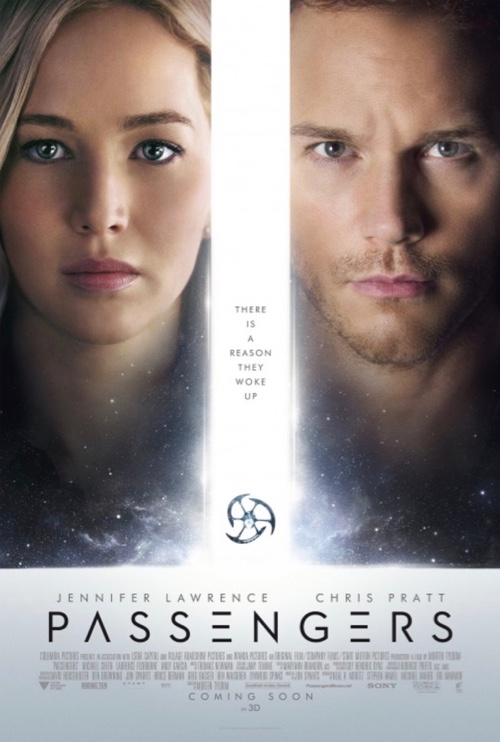
Passengers (2016)

3.5 Stars (out of four)

This movie, from the trailers, seems to be a simple story. Two people wake up from suspended animation on a long journey, fall in love and need to help each other with a disaster at the end. And while that is the general gist, it is actually a little more complicated and deeper than that, thankfully.

After a freak in-flight accident, engineer/mechanic Jim Preston (Chris Pratt) is awaken from suspended animation on a space flight from Earth to a new world Homestead II. The spaceship is a gargantuan vessel carrying over 5000 passengers. The accident caused a system malfunction and he finds he has been awakened 90 years too early on his journey. What he doesn't know is that the accident set into motion a cascading series of events that will come into play later. He awakes to find himself all alone on the ship, his only company an android bartender named Arthur (Michael Sheen). Jim spends over a year trying to fix his problem and filling his time until he comes to the brink of loneliness and despair and almost commits suicide. He then sees writer Aurora Lane (Jennifer Lawrence) in another pod. He falls into an instant longing for her and learns everything about her. He wrestles with the idea of waking her up to allay his selfish, but ultimately necessary desire for human contact. He deliberately wakes her up, despite knowing he is dooming her to his fate, to die on the ship. When she wakes, he lets her believe she, like him, was awoken by accident. Gradually, they fall in love with each other until it is revealed his deliberate act. From then on, it gets interesting...

What impressed me so much was the dynamics of how their relationship changes throughout the story. We have all seen stories like this before, but Pratt and Lawrence are such riveting actors that they totally sell the premise. This movie is essentially an acting exercise around the question of horrible betrayal and can forgiveness happen. I heard one reviewer say that it's hard to buy into it since the movie has two of Hollywood's most beautiful stars in it. One should have been a lot less attractive and that would have made the story much more interesting. While that may be the case, this is a business and you have to get butts in the seat. But in the end, I found it to be a wonderful and satisfying story that most people will like. This is definitely a good date movie, so check it out.

Sunday, December 18, 2016

Rogue One: A Star Wars Story

4 Stars (out of four)

As good as The Force Awakens was, Rogue One is really the Star Wars we have all been waiting for. Despite the bad press regarding major reshoots because Disney executives thought the tone of the film was too dark, to everybody's irrational fear that Disney would ruin Star Wars, to just the plain old naysayers who said that Rogue One was a redundant and unnecessary film because, as we all know, we already know the end. Boy, were all those people wrong and their fears totally groundless. This was a make or break film for Disney with their new franchise, and unlike The Force Awakens, Rogue One does something extraordinary. It takes us in new directions and unlocks the vast potential this franchise of franchises possese to tell amazing stories.

"It is a period of civil war. Rebel spaceships, striking from a hidden base, have won their first victory against the evil Galactic Empire. During the battle, Rebel spies managed to steal secret plans to the Empire's ultimate weapon, the DEATH STAR, an armored space station with enough power to destroy an entire planet."

With those 55 words, myself and countless other excited moviegoers were glued to our theater seats in 1977 for the film that would ultimately change most of our lives, and definitely the summer blockbuster, forever. These are the first words in the opening crawl of Star Wars, and yes, at that time it was simply Star Wars, not this Episode IV: A New Hope nonsense. It also describes exactly what we will see in this new movie. But to get a little more specific without spoilers, Rogue One is a movie about Jyn Erso (Felicity Jones), the now-outlaw daughter of Galen Erso (Mads Mikkelsen), the man who ultimately designed the power system for the Death Star. Jyn is freed from prison by a rebel, Cassian Andor (Diego Luna) and his reprogrammed imperial robot K-2SO (Alan Tudyk, who, like his character Wash in Firefly/Serenity, provides some much-needed, but not out-of-place sarcastic humor). They are given a mission by the fledgling and divided Rebellion to reach out to Saw Gerrera (Forrest Whittaker), a dangerous extremist who received an urgent message from Jyn's father regarding a new weapon being built by the Galactic Empire. This sets into motion the events that are described in the opening crawl quoted above.

So, why is this movie so great and not just a redundant and cynical cash-grab from Disney? Despite the fact we know the story, we don't know the context behind that first battle. To be fair, this is NOT required viewing for a new Star Wars fan, but it is a rewarding and satisfying chapter that explores the context behind what is to come in Episode IV. This is truly the first Star Wars movie with adults in mind first and foremost. It is long on action AND story, a key failure of the prequels, and is not simply a retread of Episode IV, a key weakness of The Force Awakens. Rather, it is a new story entirely based on an outcome we already know. This does not detract from the plot, but rather enriches what comes after the events of the movie. It establishes the stakes even more by giving crucial context to the events of A New Hope.

Chief among those elements of context are the natures of both the Rebellion and the Empire. For those of you who do not read the books, the Rebellion is far from a united organization based on a common goal and the Empire is not a monolithic entity all steering in the same direction, either. We see the Rebellion, far from being united or totally good for that matter, is fractured and divided. The events of Rogue One are a key component that forces the Rebellion to come together and act for the first time in a unified manner to defeat an existential threat to them and the universe. The Empire as well is not a hive-mind of evil devoted to one goal, but rather a collection of competing interests and ambitions which the Emperor uses to keep everyone in check under him. This makes the universe immediately more complex, diverse, and yes, "real" than the simplistic archetypes of the rest of the Star Wars series. Star Wars, at its core, is made for children. Rogue One, for the first time, dares to try to move that bar into more mature territory. It works just fine on a simple level for kids with its great action pieces. But it also works on a much deeper level, as a more nuanced, larger story, with complex characters who actually feel.

In the final analysis, this complexity is what makes Rogue One superior to every other movie in the series. It is why The Empire Strikes Back is the only other movie that actually matters. There is complex emotion and evolution in the characters and story. We see Jyn evolve from a loner criminal to determined rebel. We see Cassian change from rebel drone to free-thinking individual. Each character in this cast (and there are many), all have their evolutionary journeys that are completely realized, a not-easy feat to do in our jump-cut, action-oriented thought processes of today. This movie actually has some real meat to it in the characters and organizations that may cause you to look at each a little different when you leave. Rogue One adds real nuance to everything in the Star Wars universe, and thus changes our perception of it. For me, this was a game-changer and restored my faith in the power of moviemaking. The movie is just familiar enough to ground us in the reality, but different enough to change our perception about it in a positive and meaningful way. Screenwriters Chris Weitz and Tony Gilroy may not win an Oscar for this, but they should.

Finally, I can't leave this review without a little criticism. As much as I love it, it's not perfect. It's as close as you can get, but still falls a little short of the mark. We are given just enough information to put us in the action, but there is a lot of unmined territory that could maybe be produced in books. The territory is primarily the backstories of all the characters. Each one of them is interesting. Part of Jyn's backstory is in Catalyst, but each of the supporting characters are fascinating in their own right, particularly Saw Gerrera. There is enough to tantalize, but I would like to know more. Other than that, this movie is superb in both story and acting, and deserves a place as one of, if not the best Star Wars movie of them all.


Sunday, December 4, 2016

The Seven Samurai (1954) vs The Magnificent Seven (1960) vs The Magnificent Seven (2016)

This The Seven Samurai 3 Stars (out of four)

The Magnificent Seven (1960) 3 Stars (out of four)

The Magnificent Seven (2016) 3 Stars (out of four)

So the remakes continue. The Magnificent Seven, itself a remake of Akira Kurosawa's Seven Samurai is now being remade again in 2016, this time with a politically correct racially diverse cast. However, I like the idea of this new cast as all actually would have had a reason to be in the Old West. With today's tendency toward historical revisionism, this new version promised to be a fun and interesting remake.

The story is pretty much the same. All take off from the same general outline of The Seven Samurai, only the details change. A small, rural farming village is being robbed by a large group of approximately 40 bandits. The village elder tells some of the men to go into town to hire men experienced in fighting and weapons to train and help the villagers defend themselves. The villagers cannot afford to pay the Samurai what they would get for such services, but they promise their defenders all the food they can eat and a pittance. We have a montage of the older warrior who recruits six other men, all with different strengths. One is an old brother-in-arms, another is a killer of the greatest skill, and another is a young man who dreams of becoming a warrior. We find out this young man was a farmer as well and personally identifies with their struggles and hardships. Once the group reaches the village, all the women are missing as the villagers think the warriors will rape them. When those fears are allayed, we get more montages of training and getting ready for the big battle. In the middle of all this, the young warrior falls in love with one of the local girls, much to the dismay of her conservative father. The movie ends with the warriors fighting alongside the villagers in a battle to kill the bandits.

THE SEVEN SAMURAI (1954)

Before American audiences were watching foreign films regularly, Akira Kurosawa was one of Hollywood's go-to directors to rip off. Some of his movies that have been appropriated include this one, of course, Star Wars uses elements from both The Hidden Fortress and Throne of Blood. His film Yojimbo has been remade at least twice (Last Man Standing and A Fistful of Dollars). All three films are based on Dashiell Hammett's noir novel Red Dust. Even Kurosawa himself was not above stealing as his movie Ran is a remake of Shakespeare's King Lear, only set in feudal Japan. I guess it goes to show that if you're going to steal from somebody, steal from the best.

That said, The Seven Samurai is a wonderful movie, if just a tad overlong. I'm not one with a short attention span, but at close to 3.5 hours, this movie becomes a butt-buster. Even so, it takes its time so that we can get to know and appreciate each character. We know backstories on each Samurai and the villagers who hire them. Different motivations come into play, particularly with longtime Kurosawa-collaborator Toshiro Mifune's character. In this movie, we are introduced to him playing a character that is almost buffoonish in his broad comedic performance. He careens wildly from annoying comic relief to sullen, worldly cynic that is abrasive to all around him except the old Samurai. As we and the other characters get to know him, we see a damaged character underneath that uses bluster to hide his very deep pain at the world. He keeps people at arm's length so they will not hurt him anymore than he has been already. His arc from cynical buffoon to real hero is very satisfying because of this deliberate evolution.

The movie's (very long) climax when the samurai and the townspeople is quite exciting and entertaining. The denouement where four of the Samurai die is quite poignant as we have come to know and like each one of them. The Seven Samurai is one of those movies that just seems right to serve as the archetype of things to come. It is a work of stunning originality on the part of Kurosawa and all his collaborators behind and in front of the camera. Kurosawa is one of those legendary directors because he made great movies time and time again. This is only one of at least six of his movies that are considered classics of the film genre and he is one of the most revered and copied filmmakers of all time. Like Chaplin, Welles, Scorsese, Spielberg, Ford or Hitchcock, he is one of the templates that all aspiring filmmakers should study.

THE MAGNIFICENT SEVEN (1960)

After Kurosawa saw The Magnificent Seven for the first time, he said, "It's a wonderful movie, but it's my movie," and shortly after began legal proceedings because no one had secured the rights for remaking his picture. Once it was released, The Magnificent Seven became a classic of western action. If there was ever a movie that benefited from trimming the run time, this is definitely it. At just over two hours, this movie steams along at a great pace and never really slows down. Even at the slower points, and there are a couple, the movie is brisk with very little filler. The movie is similar in its plot, except this time it takes place in Mexico and a local ground of bandidos is terrorizing and robbing a small farming village.

My two biggest complaints of the movie are fairly minor. The biggest one was the casting of Yul Brynner. Although he is great in just about everything he ever did, the choice to cast him in the lead role is a bit off for this film. When I was younger, I hated it, but as I got to appreciate Brynner's presence, I warmed up to it. But it still rings wrong in this cast and I can't quite put my finger on it. Maybe I don't buy him as the lone outlaw with the Clint Eastwood attitude. My second complaint is a pet peeve of mine. The western genre at this time tended to be the springboard for a lot of young actors to make their mark, and producers wanted to showcase them, sometimes at the expense of the real talent we were coming to see. The most egregious example is Rio Bravo. As good as the movie is, we came to see John Wayne. Dean Martin is badly miscast and bringing in Ricky Nelson was a disaster. They even shoehorn in a song so Martin and Nelson can sing together. The offending character in The Magnificent Seven is Horst Buchholtz who plays Chico, the young man with the background of being from a similar village, a combination of two characters from The Seven Samurai. This is the critical part of the movie, but again, it feels as if they wanted to make Buchholtz the star (instead of the other soon-to-be-superstars in the stellar cast including Steve McQueen, Charles Bronson, Eli Wallach, Robert Vaughn and James Coburn). I am not saying this is Buchholtz's fault, his performance is fine. It's just a little too pronounced in an otherwise stellar, soon to be immortal cast of Hollywood action heroes for the next two decades.

In the end, The Magnificent Seven is a fine movie with a great ending, but in my opinion, falls just short of greatness. But a movie I would heartily recommend to anyone for a wild ride of rip roaring fun.

THE MAGNIFICENT SEVEN (2016)

I have held that movies are definitely a reflection of the times they are made. A movie like this one or King Arthur, Robin Hood, or Ben Hur, a story told over and over again in different generations gives a fascinating glance into how people perceive reality and their biases toward each other and their environments. Movies, being a product of popular culture, have to conform to these cultural norms in order to be embraced. For instance, D.W. Griffith's Birth of a Nation is roundly and rightly considered a cinematic classic in that it set up the modern method of cinematic storytelling structure, but it is also incredibly racist in its attitudes toward black people in general with its favorable portrayal of the KKK as the saviors of the post-Civil War Reconstruction South. The movie was embraced as a blockbuster, but is roundly reviled today in its attitudes. Westerns from the 30s through the early 60s portrayed a boyhood fantasy of what the Old West was like with bloodless gunfights and virtuous whores. Clint Eastwood's Man-With-No-Name spaghetti Westerns with Sergio Leone signified the end of the innocent Western of John Wayne and a more nihilistic Old West as a cruel, dehumanizing landscape that culminated in Eastwood's visionary anti-Western, Unforgiven. A movie that in one brilliant turn shreded every cherished trope and legend of the Old West. It could only have been done by Eastwood or Wayne, the two men most directly responsible for establishing these legends to begin with.

So why am I bringing all of this up? First to show that stories are continually adapted to meet cultural sensitivities. Also to illustrate that in a post-Unforgiven cultural landscape, we are left with a more jaundiced eye toward the portrayal of our past. In the case of the upcoming Guy Pierce's version of the King Arthur story, you have a man not born into nobility as Arthur was, but rather a street kid who ascends to the throne, a very modern type of hero. In the case of Westerns, there is a dual track of striving for historical authenticity combined with modern inclusion of as many new characters as possible, not matter how shoehorned they appear to be. Movies like Posse and The Quick and the Dead are the most egregious examples. This new version of The Magnificent Seven strikes a good compromise between the two. In a modern all-racial-inclusive cast, this movie works on all levels. No one out of place here. All the cast members have compelling reasons to be in the story, but the overall themes of justice and redemption are still in place.

In this case, the action takes place in the Wyoming territory, where an unscrupulous land baron is now trying to take the land from settlers to make way for a railroad line to his mines. He is the thoroughly modern Occupy Wall Street/Mr. Robot villain, a totally amoral rich guy that will take everything from poor people unless there is a revolution of the proletariat of sorts. No matter, the movie is great and all performances are fun to watch. I particularly like Chris Pratt, who is fast becoming the next superstar movie actor. He is very affable and comes across as a very sympathetic character, and one actor I am excited to see what he will do next. The finale is very kinetic and fun, and propels this film into a better than average action flick. A fun recommendation when you just want to turn your brain off and go with the flow.

Sunday, October 2, 2016

Westworld (1973)

3.5 Stars (out of four)

In anticipation for HBO's new sci-fi show of the same name, I decided to rewatch the original Westworld from 1973 to see if it holds up after time.  And I'm happy to say that it really does.

The plot is pretty simple.  There is a company called Talos that offers theme parks to the super rich to indulge all their fantasies and pleasures.  The three parks are Romanworld, Medievalworld and Westernworld, the final of which our two heroes (Richard Benjamin and James Brolin) have come attend.  The idea is simple:  the parks are time-based themed areas (Roman, Medieval and the Wild West) that are as real as possible, staffed by ultra-intelligent robots.  The robots can't hurt the guests, so the guests can indulge every dark passion.  This movie was one of author/director Michael Crichton's (Jurassic Park, Andromeda Strain) first movies.  It follows the Crichton template that what initially seems to be one of the coolest things imaginable will inevitably break down with disastrous results.  In this case, the park engineers are noticing the robots are all malfunctioning.  At first the issues are annoying, robots falling down, acting erratically and such.  But their erratic behavior gradually grows in intensity, such as a snake actually biting somebody or a robot refusing amorous advances from a guest. These glitches, growing in number and intensity, appear to be spreading like a disease (A...virus?  This was 1973, after all, and malicious code wasn't really a thing yet).  Eventually, the robots start killing the guests and park employees until our heroes end up running for their lives chased by a particularly psychotic gunslinger, played by Yul Brynner.

The only reason this movie doesn't get a four-star rating from me is that, in the end, the plot is a tad clunky and heavy-handed.  This was one of the few, but great, sci-fi movies films that came out between 1969's 2001: A Space Odyssey, which moved sci-fi out of the campy 1950's, until Star Wars in 1977, when sci-fi's game was upped forever into the stratosphere.  In that 8-year time frame, sci-fi was finding a new respectability as storytelling goes because of its metaphorical capacity to comment on society and trends, much as the original Star Trek did in the mid-1960's.  The 1970's are full of great sci-fi: some amazing (A Clockwork Orange, Sleeper, Logan's Run, The Omega Man, Rollerball, Soylent Green), some campy but still relevant (Death Race 2000, Damnation Alley, any of The Planet of the Apes sequels) and some just downright "what the hell were they thinking" types (Zardoz).  But the best thing thing about 1970's sci-fi is that it usually had something to say.  Star Wars, as wonderful as it is, signaled the end of thinking sci-fi and ushered in an age of movie spectacle that we are now in, very flashy with little substance.  With that said, the plot of Westworld is fairly by-the-numbers and clunky, but this was one of the movies that set the template for technology going amok and turning against us.  A little clunkiness can be forgiven when you are the original.

But there is a lot to like about this film as well.  The story is interesting and showed that Michael Crichton was not a fluke with his first effort, The Andromeda Strain.  Westworld is thought-provoking and genuinely entertaining.  Another thing I absolutely loved was that Yul Brynner essentially reprised his iconic western role from The Magnificent Seven from seven years before, down to the exact same costume.  I don't know if it as meant to be or not, but it is a sly undermining of the western myth, nineteen years before Clint Eastwood would masterfully skewer his own persona in Unforgiven.  And while I think Yul Brynner was miscast in The Magnificent Seven, he's perfect in this role.  He is so unforgettable in his intensity and relentlessness at the end of the flick, that he would be mirrored by none other than Arnold Schwarzenegger eleven years later in The Terminator, almost shot-for-shot. The other thing that makes this movie so great is its obvious impact on future designs of movies from Blade Runner, to The Terminator, to Total Recall and Robocop, to Ex Machina and HBO's new show of the same name.  We have now come full circle, back to where we began, and it promises to be a fun ride.


Friday, September 23, 2016

Don't Beathe

2 Stars (out of four)

I was actually looking forward to this.  It looked like a promising remake of sorts from Audrey Hepburn's Wait Until Dark it had my antenna up.  Unfortunately, the fact that the movie is advertising that it was made by the makers of The Evil Dead (not a bad movie, mind you), should have been my first clue was that all was not what it would seem.

The movie takes place in Detroit, and we are introduced to our main three characters, (two men, one woman) in the process of breaking into, and stealing valuables from some rich person's house.  The movie then makes a point to show that one is a true jerk, and the other two thieves are good, conscionable people merely thrown into their life of crime by economic circumstances and they are trying to get out.  The avenue out comes in the form of a blind veteran who recently won a settlement after his only daughter was hit and killed in a drunk driving accident.  He is in an economically depressed neighborhood that is literally devoid of any life besides him.  They decide to rob him and leave for California.  But it turns out that once the robbery starts and he awakens, things go south for out merry bunch of thieves as it turns out they drastically underestimated him.

This, from the premise, looked like it was going to be a great cat-and-mouse story where the thieves realized they bit off more than they could chew.  I thought it would be similar to Wait Until Dark where Audrie Hepburn plays a blind woman who is in a similar situation with some home invaders.  Alas, it was not meant to be.  In an effort to be edgy or proletarian-sympathetic, we are asked to empathize with the thieves and not the victim, sort of a reverse on Dirty Harry or Death Wish.  The movie goes out of its way to give the woman a backstory of a horrible, abusive in all aspects childhood and a being single mother herself, doing only what she has to for her beautiful little daughter; saving her from poverty and the vaguely insidious peccadilloes of her deadbeat, white-trash family.  One of the men is in unrequited love with her and works in an alarm company.  He is the trio's way in to enter the houses by stealing their security codes . He is tortured over the robberies, and is curiously well-informed of the letter of the law (our captain exposition for later).  The third, the woman's lover, is just an amoral bastard through and through, who treats her bad and belittles the other man.  Of course, he gets killed right away.  But in a frankly sickening twist, the blind man must be made even more morally reprehensible than the home-invading thieves.  I won't be a plot spoiler and reveal the secret, but the movie veers wildly away from an interesting thriller to become straight-up exploitation.  Those of you unfamiliar with the exploitation genre and what that entails, think of movies like Hostel, The Human Centipede, I Spit On Your Grave, Last House On The Left, Cannibal Holocaust, and A Serbian Film to name a few.

Since I wasn't expecting an exploitation film, this really turned my stomach.  Exploitation films have their place, but you have to warn people first.  Don't Beathe started out with an interesting premise and looked to be pretty good.  And for the first half of the film, it is fairly well realized. There is some great suspense.  The issue I had was that we are to feel sorry for criminals who break into people's houses to rob them.  When I was watching the first half, I was waiting to see if they would get their just desserts, and when the filmmakers make the blind man a twisted creature worse than the thieves, I found myself wishing the whole house would just burn down around all of them.  I think I'm supposed to root for the thieves because of their situation, but I can't.  And then the movie throws you the exploitation curve, in effect punishing you for rooting for the blind robbery victim by making him into a monster.  The movie's moral relativism ruined what would otherwise have been a pretty good hoot.  It is not, strictly speaking, a bad movie.  It sets up some very familiar tropes of a good thriller and pulls them off successfully.  You will not see anything new that you haven't seen before, but it is mildly entertaining.


Sunday, September 18, 2016

Ben-Hur: A Tale of Christ (1925) vs Ben-Hur (1959) vs Ben-Hur (2016)


Ben-Hur: A Tale of Christ (1925) 3.5 Stars (out of four)

Ben-Hur (1959) 4 Stars (out of four)

Ben-Hur (2016) 3 Stars (out of four)

For the last couple years, Hollywood has been on a binge of remakes, reboots and sequels, and if the public is to be believed, they hate it.  I think it shows the creative bankruptcy of a bloated system creaking under its own weight, churning out vanilla, non-controversial fare of familiar greats that hopefully, the entire family can get behind.  The industry is in a place that is close to pure self-immolation.  Movies have become so expensive to produce and distribute that nobody wants to take a chance anymore on anything remotely unique.  Combine that with the lessons of some costly flops in the 1970s (Heaven's Gate being the most prominent), the studios are not willing to let the inmates run the asylum, either, by ceding total creative control to the artist.  Thus, why would a studio spend mega-bucks to attempt to recreate one of the greatest epics of all time, and certainly most honored (along with Titanic and Lord of the Rings: The Return of the King, each movie has garnered 11 Oscar wins)?  It seems tantamount to career and budgetary suicide.  But as we look at each of these films, we will see there are some striking differences outside of the main story.  

To begin with, the most interesting fact is that the famous 1959 version that everyone loves is, in itself, a remake as well, from not just one, but two film versions.  In fact, Ben-Hur may be one of the most remade properties ever, with at least four movies: 1907-a 15-minute one-reeler, 1925-a 2.5 hour silent film, 1959-a 3.5 hour epic of epics, and 2016-a middling 2 hour romp.  There are also two animated versions for younger audiences (1988 and 2003-where Carlton Heston reprised his role), a 2010 3-hour British mini-series, and an awful 2016 ripoff sequel that has nothing to do with the original story.  In true Hollywood send-ups of great movies, it even has a 1995 porno parody ridiculously titled Dun Hur.  (Don't worry, that one will not be reviewed here.)  So, as you can see, Ben-Hur has been a go-to project since it debuted to raves on Broadway in 1899.  This essay is going to concern itself with the 3 big-screen adaptations from 1925, 1959 and 2016.

A quick synopsis of the plot for those of you who have lived under a rock for the last 130 years. Ben-Hur was a fictional novel written by ex-Civil War Union General Lew Wallace in 1880.  After a train ride with a friend, he realized he didn't know much about his Christian faith and set upon a course to learn as much as he could to eventually write a historically accurate account of the life of Christ.  Add in his love of romantic novels like Ivanhoe and The Count of Monte Cristo, he began writing a serialization of the Tale of the Three Magi.  After much alteration and a realization that he didn't want to write a story with Christ as the main hero, he instead penned the story of a fictional Judean prince, Judah Ben-Hur in Jerusalem.  He is betrayed by Messala, a childhood Roman friend, to a life as a galley slave.  During a battle, he saves a Roman Tribune's life.  The tribune adopts him and Ben-Hur quickly becomes a champion charioteer in Rome.  He eventually departs back in Jerusalem where Messala is the local tribune and chariot-racing champion.  Ben-Hur vows revenge inside the arena against Messala and outside the arena against Rome by joining the Jewish Zealots.  After triumphing and mortally wounding Messala in a chariot race, he sees Christ's crucifixion and becomes a Christian.  Once this conversion happens, he forgives Messala and the Romans and is able to find inner peace in his life.

A quick note on the 1907 version.  It was made without the consent of the Wallace estate, who sued for copyright violation, in a precedent-setting case decided in the Supreme Court in favor of the estate which was awarded damages.  Every artist seeking restitution for copyright-infringement has Ben-Hur to thank for being able to collect on their intellectual property.  While the overall outline of the story remains the same across each version, each version differs from the others in its own way and reflects the mood and circumstances of its times.  But what is common among all three is that they were arguably the most expensive films of their times, and at least two saved their studios from bankruptcy.  It remains to be seen whether the 2016 version will be a similar cash cow or an albatross.  All reports point to it being one of the priciest flops of all time.

BEN-HUR: A TALE OF CHRIST (1925)

Francis X. Bushman and Ramon Novarro (left to right) as Messala and Judah Ben-Hur (1925)

The 1925 version is much harsher in its portrayal of Judah and Messala.  While they did grow up together, Messala is much more racist, more Romanized than he is in the other versions. He treats Judah from the start as an inferior, with little of the brotherly affection that characterizes the other two.  So, his eventual betrayal is much less surprising according to his established character in the story.  However, this version is probably much more historically accurate considering Roman attitudes toward their subjects.  Thus, the betrayal is less dramatic, in my opinion.  Judah, on the other hand, is much more radicalized in this version, also probably more historically accurate.  He is pretty much in the zealots' camp from the start, and is extremely suspicious of Rome.  So again, his boyhood closeness stretches my credibility of the character, but makes his eventual conversion to Christianity and forgiveness of Messala in particular and the Romans in general much more dramatic.  The special effects were amazing for their time, and the chariot race is awe-inspiring. Its composition was so good that the 1959 version lifted many sequences shot-for-shot.

A couple comparisons of composition between the 1925 and 1959 versions.

For me, though, the most interesting technical element was its use of the early Technicolor process.  Silent films had been hand-painted before, or even color tinted.  Indeed, this version also has some color tinting in parts.  But what is really neat is the use of true color through the Technicolor process, which was hideously expensive and quite experimental at the time.  This was an earlier version of Technicolor that rendered three-color palettes, but had a lot of grain in it.  It was used to showcase particularly dramatic scenes, such as anything dealing with Christ or important scenes.  These color scenes were thought lost to disintegration until a copy showed up in the Czech Republic film archives in the mid-2000's with these segments intact.  Up to this point, the color segments were replaced with black-and-white segments.  Once the color segments were discovered, they were restored by Turner Archives and reinserted into their former glory.  (See below)

Mary, portrayed by Betty Bronson

Arrius' (Frank Currier) Triumphal March Into Rome

Judah Saying Goodbye To Arrius To Return To Jerusalem

Three other interesting side notes unique to the 1925 version.  It was made in the pre-Hays Code era.  The Hays Code was a self-censorship board that was established as a result of intense pressure from Congressional and the Catholic Decency League.  They held Hollywood was subverting good moral values.  Hollywood set up the board to prevent official government and religious censorship of their art.  It included prohibitions on: sex, clothing, drug use, marriage/divorce issues and law enforcement issues.  The Hays Vode lasted from the mid-1930's until the mid-1960's when the beginnings of the current MPAA code began to take effect.  But until this point, the sky was the limit.  During the 1910-20's, sword-and-sandal movies were particularly popular because they could show actors and actresses in nothing or next to nothing (See below).  By presenting them in the context of a biblical story, it was considered educational and not obscene, thus proving Hollywood was tittilating viewers from the very beginning.  There is nothing new under the sun.

Examples of pre-Code films-- clockwise from top left:  Johnny Weissmuller & Maureen O'Sullivan-Tarzan & His Mate (1934); The Sign of the Cross (1932); Theda Bara-Cleopatra (1917); Norma Shearer-A Free Soul (1931); Jeanette MacDonald & Genevieve Tobin-One Hour With You (1932); Johnny Weissmuller promo shot for Tarzan.

This version has at least two scenes of nudity, male rear ends in the gallies and topless females in the triumphal parade.  (See above).  Second, the chariot race scene featured cameos of almost every major silent film star including: Mary Pickford, Douglas Fairbanks Sr, Lionel Barrymore, John Barrymore, Myrna Loy, Clark Gable, Harold Lloyd, Joan Crawford and Gary Cooper just to name a few. Third, a young assistant director on this film was one William Wyler.  This same William Wyler would go on to win the 1960 Academy Award for Best Director for another Ben-Hur starring Charlton Heston.

BEN-HUR (1959)

Stephen Boyd as Messala and Charlton Heston as Judah Ben-Hur (1959)

By the time the next iteration of Ben-Hur came about, TV was killing the movies.  More and more families had a TV, and studios were facing some very hard times.  The studios realized they had to improve their game if they were to survive, so they decided to make an experience that TV couldn't replicate. At this point, all TV screens are small and black-and-white.  Movies went in the opposite direction with bigger and brighter and more colorful stories, and thus the movie epic is born.  Cecil B. DeMille kicked it off in 1956 with a remake (there it is again) of his 1926 biblical epic The Ten Commandments to huge box office receipts and positive critical reception, as well as becoming a huge financial shot in the arm for Paramount Studios.  The struggling MGM Studios decided to replicate the idea with an even bigger film and gambled everything on its success.  From the start, Ben-Hur was going to be big.  With screenwriter Gore Vidal and director William Wyler, the studio set out, like it did in 1925, to make the biggest spectacle the world ever saw.  Both movies, in their times, were the most expensive films ever made, and both saved the studio.

The 1959 version is hard to criticize.  It is almost the perfect movie.  While the acting can be a little hammy at times, particularly Charlton Heston's performance, that is not necessarily a bad thing.  Everything about this film is huge, from its theme to its aspect ratio, one of the largest ever at 2:76:1.  A little over-the-top acting by a star who was larger-than-life himself, seems to fit this story.  Judah's relationship with Messala also changed.  Gore Vidal wrote the characters to be much closer at the beginning and made subtle hints that there was a deep, emotional bond between the two men, possibly even a homosexual one.  He wrote Messala's character to reflect this, as a man trying to restart an old flame from the past which Judah rejects out if turn.  Messala's reaction, that of a spurned lover as well as naked ambition, becomes much more nuanced.  Wyler and Vidal conferred with Stephen Boyd, who played Messala, about this.  Nobody told the conservative Heston, and the tension does come through.  Being that this was 1959, and a biblical epic to boot, albeit a fictional one, this had to be done extremely subtly.  Wyler would go on record later denying the homosexual subtext, but Vidal insists this was a strategy agreed to early on.  In any case, whether true or not, the friendship is much more believable.  It is also so much more tragic with Messala's ultimate betrayal and eventual death.  Judah's conversion and forgiveness is also more believable as his arc brings him full circle.  He is essentially a non-violent man trying to get along with the Romans, becomes an out-and-out rebel until his conversion to Christianity at the end, where he renounces the destructive path which would have led him to ruin.  Great, heady material for an incredible story.

Finally, one cannot leave a discussion of the 1959 movie without discussing the two major set pieces: the naval battle and chariot race.  Like the 1925 movie, these are both the centerpieces of each film.  The naval battle in 1925 actually had featured two full-size gallies that caught on fire, almost killing star Ramon Novarro in the process.  The battle in 1959 features some of the most amazing miniature work, and a surprisingly explicit brand of violence during the actual battle.  But if that was something to see, the climatic chariot race was nothing short of extraordinary.  There are not enough superlatives to properly describe that race.  In my opinion, it is the best action scene ever filmed, and set the bar for future great sequences as the car chase in Bullitt, the scenes from the Indiana Jones movies, the freeway chase in The Matrix: Reloaded, to its most obvious progeny, the pod race scene in Star Wars: Episode I-The Phantom Menace.  It was bigger and more spectacular than anything before or since, and contrary to rumor, no one was killed or seriously injured in the filming of the sequence.

Toby Kebbell as Messala Severus and Jack Huston as Judah Ben-Hur (2016)

BEN-HUR (2016)

Finally, the 2016 version differs a lot from the other two versions with some significant story changes. First, the running time is much shorter at just over two hours.  In this version, Judah is almost a pacifist, wanting absolutely nothing to do with the zealots. The biggest change of all is that the entire Quintus Arias story is totally cut.  On top of that, the naval battle scene is drastically truncated.  We see the entire sequence from the point of view of the galley slaves and see very little of the actual battle.  Whether this was done to save time or money, we'll never know.  But it is a shame these action and dramatic scenes are gone. The action is exciting and the time with Arias gives Judah a chance to grow and advance in his character arc.  It also makes the reunion with Messala much more believable if he thinks that Judah is a Roman dignitary.  The reveal is much more dramatic and interesting.  The relationship between Judah and Messala is also dramatically different.  In this case, they grew up in the same household as brothers, Messala having been adopted by the Hur family.  

The most grevious change is the actual ending of the film.  WARNING!!!  SPOILERS AHEAD!!!  In both the previous films, Messala dies without Judah's forgiveness, miserable and alone.  With Judah's conversion, both previous versions show that when Judah lets go of his hate, he can live with an internal peace, happily ever after, in a way.  But this version is a total betrayal of this complicated dynamic by giving into the temptation of a typical Hollywoid happy ending.  Judah sees Messala, broken and dying.  After a few terse words and Judah's forgiveness, Messala breaks down into a blubbering mess and begs forgiveness.  He then immediately renounces his Roman-ness and ends up leaving with the Hur family, bringing their relationship full circle.  Messala's total change of heart is totally out of character and makes no logical sense whatsoever.  The movie was actually pretty good up until the end. The end totally spoils the film for me.

So, in conclusion, all the films are good in their own way.  They reflect the popular attitudes of their respective times.  This is most evident in Judah's character and the nature of Judah and Messala's relationship.  This is what ultimately separates each film and determines its quality. On that measure, the 1959 film stands out as the best as pure entertainment, but the 2016 version is the most realistic in the world that is created.  The 2016 version is good and worth watching.  But sadly, it does not live up to the bar set by the previous two.  This is too bad, because this was a lost opportunity to make a wonderful film.  As it is, it is merely good.  It could have been great.  It isn't larger than life, but rather a simple little story with large events around it.